Russia has signalled that “radical changes” are needed to the US-Ukraine peace plan despite a US envoy saying that the end to the war is “really really close”.
President Vladimir Putin’s top foreign policy aide Yuri Ushakov was quoted by Russia media on Sunday saying that the United States would have to “make serious, I would say, radical changes to their papers” on Ukraine. He did not clarify what changes Moscow wanted Washington to make.
However US special envoy for Ukraine Keith Kellogg told a defence forum that a deal to end the Ukraine war was “really close” and depending on resolving two issues. These are the future of Ukraine’s Zaporizhzhia nuclear power plant, and the future of the Donbas region.
President Volodymyr Zelensky said last night that the “next steps” for talks with the United States about post-war Ukraine have been agreed.
In a post to social media platform X, Mr Zelensky said that he had had a call with president Donald Trump’s envoy Steve Witkoff and Mr Trump’s son-in-law Jared Kushner to catch-up about the third day of talks.
Man killed in Russian drone attack on Ukraine overnight
Russian missile and drone attacks overnight into Sunday killed at least one person in Ukraine.
A man was killed in a drone attack on Ukraine’s northern Chernihiv region Saturday night, local officials said, while a combined missile and drone attack on infrastructure in the central city of Kremenchuk caused power and water outages.
Kremenchuk is home to one of Ukraine’s biggest oil refineries and is an industrial hub.
Kyiv and its Western allies say Russia is trying to cripple the Ukrainian power grid and deny civilians access to heat, light and running water for a fourth consecutive winter, in what Ukrainian officials call “weaponizing” the cold.
The latest round of attacks came as Ukrainian President Volodymyr Zelenskyy said Saturday evening he had a “substantive phone call” with American officials engaged in talks with a Ukrainian delegation in Florida.
He said he had been given an update over the phone by US and Ukrainian officials at the talks.
Putin’s top foreign policy aide tells Russian media ‘radical changes’ needed to Ukraine peace plans
Vladimir Putin’s top foreign policy aide Yuri Ushakov has told Russian media that the United States will have to “make serious, I would say, radical changes to their papers” on Ukraine.
His comments come as US and Ukrainian officials have finished three days of talks about plans for post-war Ukraine. President Donald Trump’s special envoy Steve Witkoff spent four hours with president Putin this week.
Mr Ushakov did not clarify what changes Moscow wanted Washington to make.
Ukraine’s president Zelensky said on Saturday that he had had a long and “substantive” phone call with Mr Witkoff and Mr Trump’s son-in-law Jared Kushner.
The Kremlin has said it expect Mr Kushner to be doing the main work on drafting a possible peace deal.
Russian strike hits Ukrainian city of Kremenchuk, cutting utilities, mayor says
Russian forces launched an overnight combined air strike on infrastructure in the central Ukrainian city of Kremenchuk, causing power and water outages, its mayor Vitalii Maletskyi said on Sunday.
Located on the Dnipro River, Kremenchuk is a major industrial hub and home to one of Ukraine’s biggest oil refineries. The city has been repeatedly hit by Russian missiles, including a 2022 strike on a crowded shopping mall that killed at least 21 people.
Maletskyi said in a social media post that details of consequences of the strike would be released later on Sunday after damage assessment is completed. City services were working to restore electricity, water and heating in districts where supplies were disrupted, he added. Russia has intensified long-range strikes on Ukraine’s power, heating and water infrastructure ahead of winter and seeking to sap public morale and disrupt industry after previous cold seasons in the nearly four-year war saw nationwide blackouts and emergency rationing.
A photo posted by the mayor showed a large blaze engulfing what looked like industrial buildings at night.
“We will restore everything,” he wrote.
Deal to end Ukraine war is ‘really close’, Trump’s Ukraine envoy says
A deal to end the Ukraine war was “really close” and now depends on resolving just two main outstanding issues, president Donald Trump’s outgoing Ukraine envoy has said.
The two issues are the future of Ukraine’s Donbas region and the Zaporzhzhia nuclear power plant.
US special envoy for Ukraine Keith Kellogg, who is due to step down in January, told the Reagan National Defence Forum that efforts to resolve the conflict were in “the last 10 metres” which he said was always the hardest.
Speaking about the nuclear power plant and the future of the Donbas, he said: “If we get those two issues settled, I think the rest of the things will work out fairly well. We’re almost there. We’re really, really close”.
Russian forces reportedly take control of two villages in Ukraine
Russian forces have taken control of the villages of Kucherivka in Ukraine’s northern Kharkiv region and Rivne in the eastern Donetsk region, the Russian Defence Ministry has said.
Moscow carried out group strikes on Ukrainian transport infrastructure, fuel and energy facilities, military airfields and long-range drone complexes, the ministry added.
The battlefield reports could not be independently verified.
Ukraine at ‘pivotal moment’ says UK minister ahead of London talks
Ukraine faces a “pivotal” moment as Volodymyr Zelensky prepares to visit London for talks on peace proposals, a senior UK minister has said.
The Ukrainian president will meet Sir Keir Starmer in Downing Street on Monday along with French President Emmanuel Macron and German Chancellor Friedrich Merz.
Their meeting comes amid continued talks between Ukrainian and US officials on a Washington-backed plan to end the war.
On Sunday, Cabinet minister Pat McFadden said Ukraine’s security and self-determination would be “at the heart” of the leaders’ discussions.
He told Sky News’ Sunday Morning With Trevor Phillips: “The principle behind the talks will be for Ukraine to be able to decide its own future.
“This is a really pivotal moment now. Everybody wants the war to come to an end, but they want it to come to an end in a way that gives Ukraine that freedom of choice in the future.
“So, that means not just an end to the war but also security guarantees for Ukraine in the future, and not a completely toothless organisation which is unable to decide its future.”
British soldiers join major exercise in the Artic
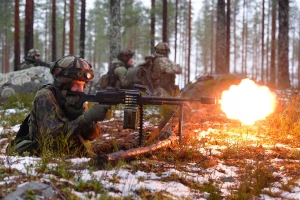
British soldiers joined a major exercise on Nato’s snowy border with Russia as Finnish troops prepare to defend their country if their neighbour invades.
Around 50 men from the 3 Rifles, based in Edinburgh, spent six weeks training in the Arctic north of Finland, where they honed their survival skills in temperatures as low as minus 28C.
The C Company soldiers, who have previously had hot weather training in Kenya and Morocco, learned how to cope with icy immersion in water and how to avoid frostbite, and practised fighting in the snow and shooting while skiing.
They then joined the 3,000 conscripts, reservists and regulars from the Finnish Army’s Kainuu Brigade on Operation Northern Ax, in the forests of Vuosanka, around 20 miles from Russia and 400 miles north of Helsinki.
The British reconnaissance specialists carried out operations alongside the Finns on a wide-ranging and sophisticated simulated battle which lasted for five days and nights.
The operation was designed to test their defence, delaying, night combat and attack tactics, with commanders following the troops’ movement in real time to monitor their performance.
UK troops join Nato exercise as Finland prepares for potential Russian invasion
Czech president says Ukraine war echoes start of WW2
Speaking to the Sunday Times, Czech president Petr Pavel says Vladimir Putin’s attempts to grab land from Ukraine echo Adolf Hitler’s actions against neighbouring countries – including Czechoslovakia – that preceded the Second World War.
Pavel says Putin’s argument that he is acting in the interests of Russian-speaking people living in eastern Ukraine is particularly alarming to those familiar with Czech history.
“For Czechoslovakia, the German minority [in the Sudetenland] was used as a pretext,” Pavel said. “The same narrative is used by Vladimir Putin.”
He said Europe and the US’s appeasement of Russia represents a failure to stand up for Western values.
“What we are doing now, I wouldn’t call it a betrayal of Ukraine,” he said. “I would call it reluctance – reluctance to protect the principles we all claim to protect.
“If we allow Russia to come out of this conflict as a victor, we have all lost.”
Trump’s peace plan has ‘evolved since it was first presented’
Donald Trump’s 28-point peace plan for Ukraine has “evolved since it was first presented”, a Cabinet minister has argued.
It comes ahead of talks between Sir Keir Starmer, Volodymyr Zelensky, Emmanuel Macron and Friedrich Merz in Downing Street tomorrow.
Asked whether the prime minister would be able to tell the US president that the plan doesn’t work for Ukraine, Pat McFadden told Sky News: “I think that 28-point proposal has evolved since it was first presented. And the European leaders have played a role in that, as of course, has the Ukrainian leadership itself.
“So there are a lot of points to be discussed, but the principle will be the same, which is to let Ukraine decide its own future here, and not to reward Russian aggression, both in terms of the end state on the battlefield, but perhaps even more importantly, in terms of Russia’s ability to dictate Ukraine’s future.”